Skip to content

Early-bird: RM 249.00 (normally RM 349.00) · 92 of 100 slots left Claim yours

Orbit Finance

Accounting terms every Malaysian SME should know

Accounting terms describe the documents, records and reports that turn daily transactions into useful business information. For a Malaysian SME, the essentials include invoices and receipts, ledgers and journal entries, receivables and payables, the trial balance, financial statements, SST and LHDN's MyInvois system.

Key points

  • Documents record what was offered, billed and paid.
  • Ledgers organise every transaction by account.
  • Financial statements explain performance and financial position.
  • RMCD administers SST, while LHDN runs MyInvois.

Which everyday documents should you know?

Quotation
A price offer sent before a sale. It's a proposal, not a request for payment.
Invoice
A request for payment issued after you agree to supply. It's the tax document and creates a receivable.
Receipt
Proof that payment was received. Issued after the customer pays.
Credit note
A document that reduces or cancels an invoice, e.g. for a return or a correction.

How do ledgers and entries work?

Chart of accounts
The organised list of every account your business uses to record money (sales, expenses, bank, assets, and so on).
General ledger
The master record where every transaction is posted, grouped by account.
Journal entry
A single recorded transaction. In double-entry, its debits and credits must be equal.
Debit & credit
The two sides of every entry. Total debits must equal total credits for the books to balance.
Accounts receivable (AR)
Money your customers owe you for invoices not yet paid.
Accounts payable (AP)
Money you owe suppliers for bills not yet paid.
Bank reconciliation
Matching your books to your bank statement so the two agree.

Which financial statements should you understand?

Trial balance
A check that total debits equal total credits across all accounts before you produce statements.
Profit & loss (income statement)
Revenue minus expenses over a period. Shows whether you made a profit.
Balance sheet
A snapshot of what you own (assets), owe (liabilities) and the difference (equity) at a point in time.
Cash flow
The movement of money in and out of the business over a period.
Cost of goods sold (COGS)
The direct cost of the goods or services you sold: stock, materials, direct labour.
Gross vs net profit
Gross profit is revenue minus COGS; net profit is what's left after all expenses.
Accruals
Recording income and expenses when they're earned or incurred, not only when cash moves.

Which Malaysian tax and compliance terms matter?

SST
Sales & Service Tax, Malaysia's consumption tax, administered by RMCD (Customs).
e-Invoice / MyInvois
LHDN's electronic invoicing system. Invoices are submitted and validated with a unique ID.
Financial year
The 12-month period your accounts cover. Records must generally be kept seven years.
Which accounting terms should you learn first?

TermPlain meaningWhere it appears
InvoiceA request for payment after supply is agreedSales
ReceivableMoney a customer still owes youBalance sheet
PayableMoney you still owe a supplierBalance sheet
Gross profitRevenue less direct cost of salesProfit & Loss
Bank reconciliationMatching the books to the bank statementLedger review

What do these terms look like in an RM example?

Example only: you issue an invoice for RM2,000. Until the customer pays, RM2,000 is a receivable. When the payment reaches the bank, you match it during bank reconciliation. The sale remains in revenue, while any direct cost belongs in cost of goods sold.

How Orbit Finance handles this

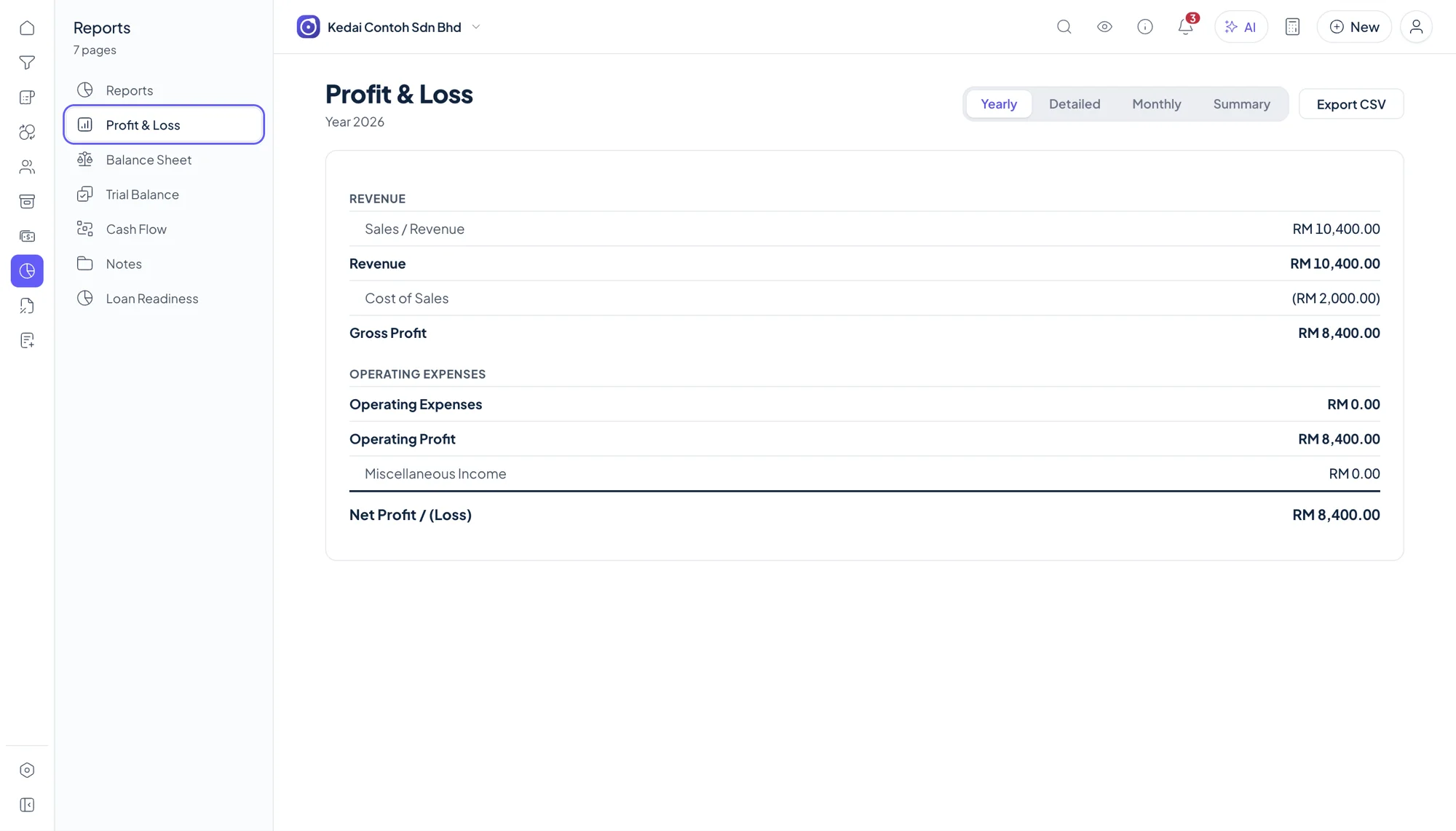
Orbit Finance keeps sales, purchases, money and reports connected, so the terminology maps to records you can inspect instead of abstract accounting jargon.

  • Invoices flow into receivables
  • Bills flow into payables
  • Reports update from the same ledger entries
Orbit Finance profit and loss for 2026: revenue RM 10,400.00, gross profit RM 8,400.00, net profit RM 8,400.00

Questions, answered

What is the difference between a ledger and a journal entry?

A journal entry records one transaction using debits and credits. The general ledger is the master record that groups those posted entries by account.

What are accounts receivable and accounts payable?

Accounts receivable is money customers owe you. Accounts payable is money you owe suppliers for bills that have not yet been paid.

How are a Profit & Loss statement and balance sheet different?

A Profit & Loss statement reports revenue, expenses and profit over a period. A balance sheet shows assets, liabilities and equity at one point in time.

Are SST and e-Invoice the same thing?

No. RMCD administers SST as a consumption tax. LHDN runs MyInvois, which validates electronic invoices. A business may need to deal with both.